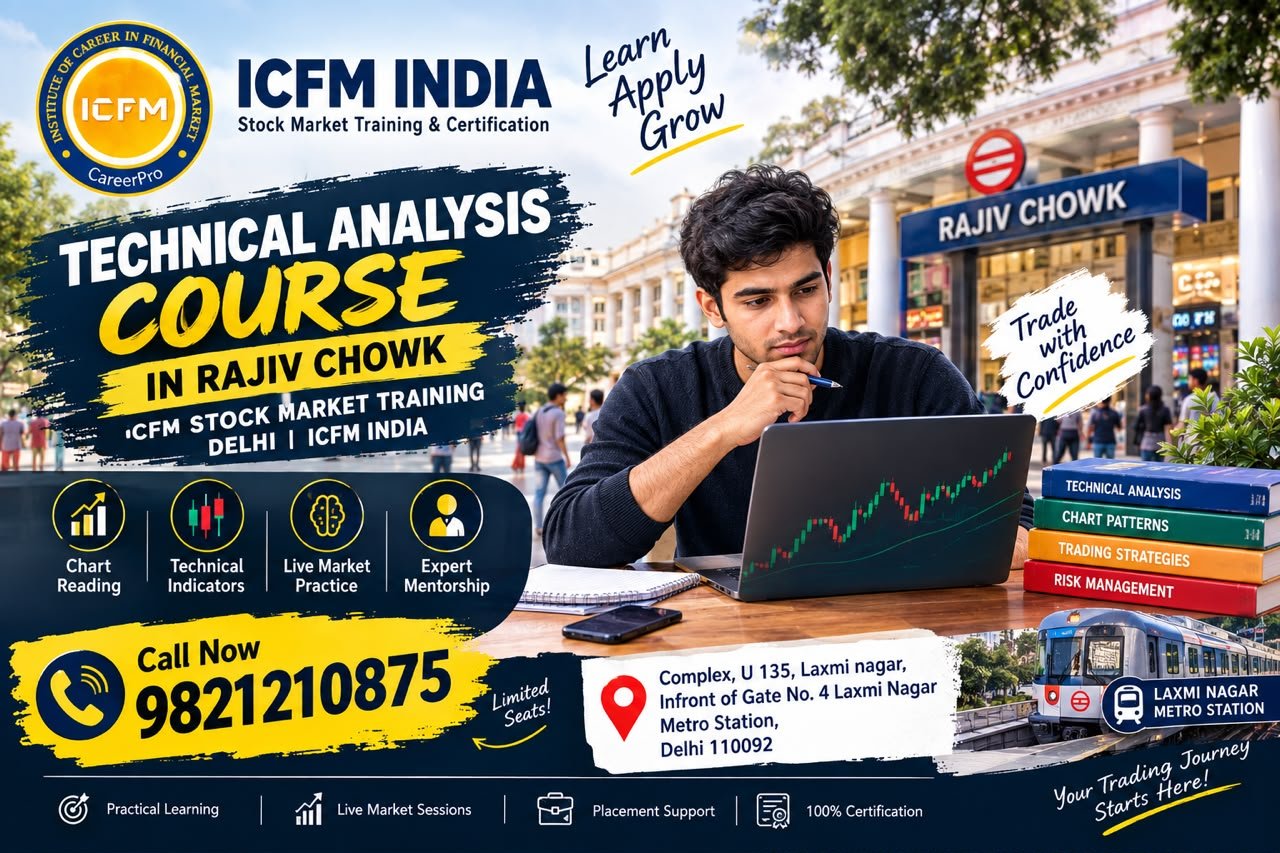

Learn trading with ICFM’s practical and career-focused Best Trading Course in Connaught Place (CP), covering technical analysis, trading strategies, risk management, market tools and financial-market fundamentals
Learn Trading with a Structured, Practical Approach
Searching for the best trading course in Connaught Place (CP) can be confusing. There are plenty of online videos, social-media tips, trading communities and short-term programs available today. However, learning how to place an order is very different from learning how to analyse a market, manage risk and develop a disciplined trading process.
A professional trading course should therefore go beyond basic terminology.
At ICFM – Institute of Career in Financial Market, the focus is on helping learners understand the financial markets through structured education, practical concepts, technical analysis, fundamental analysis, risk management and market-oriented training.
Whether you are completely new to trading or already understand the basics, a systematic learning path can help you develop stronger market knowledge and more disciplined decision-making.
Why Learn Trading Professionally?
The stock market can appear simple from the outside.
Buy a stock.
Sell a stock.
Watch the price move.
But professional trading involves considerably more.
A trader needs to understand:
- Market structure
- Price behaviour
- Technical analysis
- Fundamental factors
- Trading setups
- Entry and exit planning
- Risk-to-reward concepts
- Position sizing
- Stop-loss management
- Trading psychology
- Market news and events
- Trading platforms and order execution
Without a structured process, beginners can easily move from one strategy to another without understanding why a particular setup works or fails.
That is why professional trading education should focus on understanding the process rather than chasing quick profits.
Best Trading Course in Connaught Place (CP): What Should You Look For?
The word “best” can mean different things to different learners.
For one student, practical training may be the priority. Another learner may want technical analysis. A working professional may prefer flexible classes, while someone planning a career in finance may be more interested in job-oriented market education.
Before selecting a trading course, consider these factors:
1. Practical Market Knowledge
A course should explain how concepts apply to actual market situations instead of relying entirely on textbook definitions.
2. Technical Analysis
Learners should understand charts, trends, price action, candlesticks, support and resistance, indicators and trading setups.
3. Risk Management
Trading education should give serious attention to protecting capital. Risk management is an essential part of responsible market participation.
4. Trading Psychology
Emotions can influence trading decisions. Understanding discipline, patience and consistency is therefore an important part of learning.
5. Trading Tools
Modern traders use charting platforms, screeners, market data and analytical tools. Learning how these tools work can make market analysis more structured.
6. A Progressive Curriculum
Beginners should not be pushed directly into advanced strategies. A good learning journey should progress from fundamentals to analysis, strategy development and practical application.
What Makes ICFM's Trading Training Different?
ICFM approaches trading education as a skill-development process.
Instead of presenting trading as a shortcut to making money, the learning approach focuses on understanding markets, developing analytical skills and building responsible trading habits.
ICFM's current course information highlights areas including technical analysis, options trading, algorithmic trading, fundamental analysis, futures trading and portfolio management.
The objective is to give learners a broader understanding of the financial-market ecosystem.
Key Learning Areas
Market Fundamentals
Understand exchanges, market participants, equity markets and basic trading terminology.
Technical Analysis
Learn to interpret charts and identify trends, price structures, candlestick formations, support and resistance and technical indicators.
Fundamental Analysis
Understand company financials, business performance, sector analysis and factors that can influence investment decisions.
Trading Strategies
Explore different approaches including intraday, swing and positional trading concepts.
Derivatives & Options
Build an understanding of futures, options, contracts, margin and the risks associated with leveraged instruments.
Risk Management
Learn concepts such as stop-loss planning, position sizing, capital allocation and risk-reward assessment.
Trading Psychology
Understand how discipline and emotional control can affect decision-making.
Market Tools
Become familiar with charting platforms, scanners and other market-analysis tools.
A Course Designed for Different Types of Learners
Not everyone joins a trading course for the same reason.
ICFM's trading education can be relevant for:
College Students
Students interested in finance can use structured market education to develop practical knowledge alongside their academic studies.
Beginners
If you have never analysed a chart or placed a trade, starting with fundamentals can provide a clearer foundation.
Working Professionals
Professionals can explore financial-market knowledge as an additional skill and learn through suitable classroom or online formats.
Aspiring Traders
Learners interested in trading can study technical analysis, strategy development and risk management in a structured environment.
Investors
People interested in long-term investing can benefit from understanding company fundamentals, valuation concepts and portfolio principles.
Career Seekers
Learners interested in financial-market careers can develop knowledge relevant to areas such as broking, research, trading operations and investment support.
Technical Analysis: A Major Part of Trading Education
Technical analysis is one of the most important areas for people who want to understand price behaviour.
A structured program can introduce learners to:
- Candlestick patterns
- Trend identification
- Support and resistance
- Chart patterns
- Volume analysis
- Moving averages
- Momentum indicators
- Oscillators
- Breakouts and breakdowns
- Price action
- Entry and exit planning
- Multi-timeframe analysis
The objective is not to memorise dozens of indicators.
Instead, learners should understand why a particular tool is being used, what information it provides and what its limitations are.
That approach can make technical analysis much more meaningful.
Fundamental Analysis for Better Investment Understanding
Trading and investing are related, but they are not identical.
While technical analysis primarily studies price and market behaviour, fundamental analysis examines the underlying business and economic factors.
Learners can explore:
- Balance sheets
- Profit and loss statements
- Cash-flow statements
- Revenue and earnings
- Business models
- Industry analysis
- Sector trends
- Economic indicators
- Valuation concepts
- Company comparison
Understanding both technical and fundamental perspectives can give learners a broader view of the market.
Risk Management: The Part Beginners Should Not Ignore
One of the biggest mistakes beginners can make is concentrating only on potential returns.
A responsible trading education program should also teach learners how to think about potential losses.
Important concepts include:
Position Sizing
How much capital should be exposed to a particular trade?
Stop-Loss Planning
At what point should a trade idea be considered invalid?
Risk-Reward Assessment
Does the potential reward justify the amount of risk being taken?
Capital Allocation
How should available capital be distributed rather than concentrated unnecessarily?
Leverage Awareness
How can leverage increase both potential gains and potential losses?
Trading involves market risk, and no educational program can guarantee profits or eliminate losses.
The purpose of training is to improve knowledge, preparation and decision-making—not to promise a particular financial outcome.
Practical Learning Instead of Random Trading Tips
The internet provides unlimited trading information.
But information without structure can become overwhelming.
A beginner might watch one video about candlesticks, another about options, another about indicators and another about intraday trading. After several weeks, they may know many terms but still lack a coherent trading framework.
A structured course changes that learning experience.
Instead of asking:
“Which stock should I buy today?”
learners should gradually learn to ask:
“What is the market trend?”
“What evidence supports this trade idea?”
“Where is the setup invalidated?”
“How much capital should be exposed?”
“What is my exit plan?”
“What did I learn from the previous trade?”
This shift from prediction to process is an important part of developing trading discipline.
Why Connaught Place (CP) Is Relevant for Finance Learning
Connaught Place is one of central Delhi's major commercial areas and has strong connectivity with surrounding business districts.
For students, professionals and job seekers in central Delhi, a training program in or around the CP area can make regular classroom learning convenient.
At the same time, location should not be the only factor when selecting a financial-market institute.
Learners should also evaluate:
- Curriculum
- Faculty experience
- Practical exposure
- Course duration
- Learning format
- Certification details
- Career support
- Training methodology
- Transparency about fees and outcomes
ICFM also offers classroom and online learning formats according to its current course information.
From Beginner Concepts to Professional Market Skills
A well-designed trading curriculum can follow a logical learning journey.
Stage 1 – Understand
Learn how the stock market works and become familiar with important financial terms.
Stage 2 – Analyse
Study charts, price movements, company information and market conditions.
Stage 3 – Plan
Develop trading setups and define entry, exit and risk parameters.
Stage 4 – Practise
Apply concepts to market situations and review the reasoning behind decisions.
Stage 5 – Review
Maintain a trading journal and analyse what worked, what failed and what needs improvement.
Stage 6 – Develop Discipline
Build consistency instead of constantly switching between strategies.
This process helps turn scattered market information into a more organised learning framework.
Career Opportunities After Learning Trading & Financial Markets
Financial-market education can support several career directions, depending on a learner's qualifications, skills and experience.
Possible areas include:
- Equity Dealing
- Trading Operations
- Research Support
- Technical Analysis
- Investment Operations
- Portfolio Support
- Client Relationship Roles
- Market Research
- Broking Operations
- Financial Market Training
Career outcomes are not automatic. Employment depends on individual qualifications, skills, experience, interview performance and employer requirements.
For someone pursuing a professional career, trading education can therefore be treated as one component of broader financial-market skill development.
Who Can Join a Trading Course?
You do not necessarily need to be an experienced trader to begin learning.
The course can be considered by:
- Beginners
- College students
- Graduates
- Working professionals
- Career changers
- Entrepreneurs
- Existing traders
- Investors
- Finance enthusiasts
The right starting level depends on your existing knowledge and learning objectives.
Common Mistakes New Traders Should Avoid
Trading Without a Plan
Entering a position simply because a stock is moving can result in impulsive decisions.
Following Random Tips
Social-media calls and unverified recommendations should not replace independent analysis.
Ignoring Risk
A strategy without risk management can expose trading capital to unnecessary losses.
Using Excessive Leverage
Leverage can magnify both gains and losses and should be understood before being used.
Expecting Guaranteed Returns
There is no genuine trading strategy that can guarantee profits in changing market conditions.
Changing Strategies Too Quickly
A learner needs enough time to understand, practise and evaluate a strategy before abandoning it.
Why Choose ICFM for Trading Education?
ICFM – Institute of Career in Financial Market focuses on financial-market education and currently lists areas such as technical analysis, options trading, futures trading, fundamental analysis, algorithmic trading and portfolio management.
For learners considering a trading course, the emphasis can be placed on:
Structured Curriculum
Progress from foundational concepts toward more advanced market topics.
Practical Orientation
Connect theoretical concepts with market-based examples and analysis.
Multiple Learning Formats
Explore classroom, online and other training formats depending on course availability.
Career Awareness
Understand how different financial-market skills connect with potential professional roles.
Continuous Skill Development
Trading and investing require ongoing learning because markets, technology and financial products continue to evolve.
ICFM – Your Learning Destination for Financial Market Education
ICFM – Institute of Career in Financial Market
Address:
Complex, U 135, Laxmi Nagar,
In Front of Gate No. 4, Laxmi Nagar Metro Station,
Delhi – 110092
Phone: +91 9821210875
Email: info@icfmindia.in
Website: www.icfmindia.in
For learners searching for the Best Trading Course in Connaught Place (CP), ICFM provides a structured route to explore trading, technical analysis, investment concepts and broader financial-market skills.
The goal should not be to find a course that promises instant success.
The goal should be to find an educational program that helps you understand the market, practise systematically, manage risk and develop skills that can continue to grow with experience.
Start Your Trading Education with a Strong Foundation
The stock market does not reward shortcuts consistently. It requires knowledge, preparation, discipline and continuous learning.
If you are starting your trading journey from Connaught Place or anywhere in Delhi, begin with the fundamentals, develop analytical skills, understand risk and build your approach step by step.
ICFM can help you build that learning foundation.

ICFM Admin
Senior Trading Analyst at ICFM India
Rahul Rai is a certified market professional with over 12 years of experience in equity and derivatives trading. He specializes in technical analysis and margin trading strategies, and has trained over 5,000 students through ICFM India's certification programs.