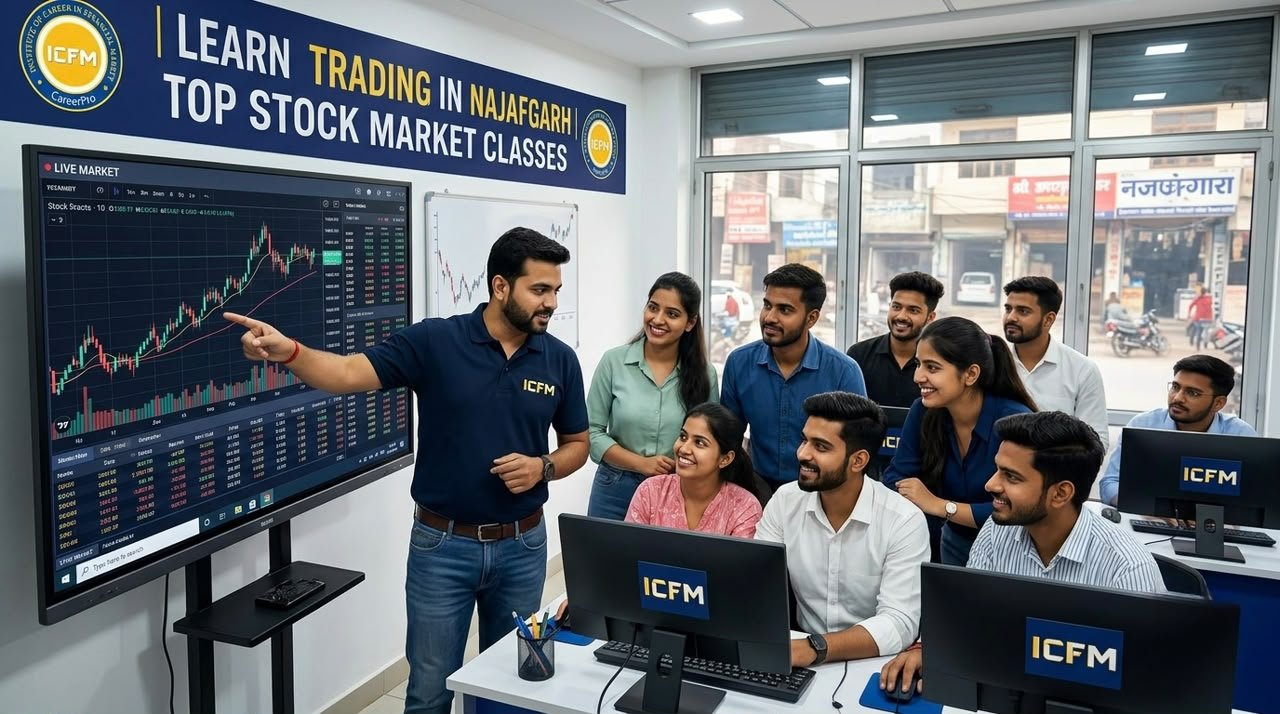

Learn how to trade in Subhash Nagar with ICFM. Build practical knowledge of stock market basics, technical analysis, trading strategies, risk management and market psychology through structured financial-market training.
Learning trading is not simply about knowing when to buy or sell a stock. A successful trader needs to understand market behaviour, price movements, technical analysis, risk management, trading psychology and disciplined execution.
If you are searching for how to learn trading in Subhash Nagar, the best approach is to follow a structured learning path instead of depending entirely on random YouTube videos, social media tips or unverified trading calls.
For beginners in Subhash Nagar and nearby areas, professional stock market education can provide a more organized way to understand the markets, practise analysis and develop the skills required for responsible trading.
ICFM – Institute of Career in Financial Market provides practical financial-market education designed to help students, working professionals, beginners and aspiring market professionals understand trading and investment concepts through structured learning.
Why Should You Learn Trading Before You Start Trading?
The stock market gives people access to a wide range of opportunities, but trading without proper knowledge can also expose a person to significant financial risk.
Many beginners start their journey by following:
- Social media trading tips
- Telegram or WhatsApp calls
- Random indicators
- Unverified strategies
- Tips from friends
- Short videos without proper context
The problem is that these methods rarely explain why a trade should be taken, where risk should be controlled or when a trader should stay out of the market.
Learning trading systematically helps you understand the decision-making process behind a trade.
Instead of asking only, “Which stock should I buy?”, you learn to ask better questions:
What is the market trend?
What does the chart indicate?
Where is the entry point?
Where should the stop-loss be placed?
What is the potential risk-to-reward ratio?
What market conditions could invalidate the setup?
These questions form the foundation of disciplined trading.
A Beginner-Friendly Way to Learn Trading in Subhash Nagar
If you are starting from zero, avoid trying to learn everything at once. Trading can be divided into several important areas, and each should be learned progressively.
1. Understand How the Stock Market Works
Before studying complicated indicators, first understand the market itself.
A beginner should learn about:
- NSE and BSE
- Equity markets
- Trading accounts and demat accounts
- Market participants
- Order types
- Market orders and limit orders
- Bid and ask prices
- Trading sessions
- Settlement concepts
- Brokerage and other trading costs
This foundation makes later topics much easier to understand.
2. Learn the Difference Between Trading and Investing
Trading and investing are related but different activities.
Trading generally focuses on shorter-term price movements, while investing usually focuses on building wealth through longer-term ownership of assets.
A learner should understand different approaches such as:
- Intraday trading
- Swing trading
- Positional trading
- Long-term investing
There is no single method that is suitable for everyone. Your approach should depend on your knowledge, objectives, risk tolerance, available time and financial situation.
3. Develop Technical Analysis Skills
Technical analysis is one of the core subjects for people interested in trading.
It involves studying price and volume information to identify possible market patterns and trading setups.
A structured trading course should introduce concepts such as:
Candlestick Analysis
Learn how candles represent price movement and how combinations of candles can provide information about market behaviour.
Support and Resistance
Understand important price areas where buying or selling pressure may appear.
Trend Analysis
Learn how to identify:
- Uptrends
- Downtrends
- Sideways markets
- Higher highs and higher lows
- Lower highs and lower lows
Chart Patterns
Understand commonly discussed formations and, more importantly, learn how to evaluate whether a pattern actually provides a reasonable trading setup.
Indicators
Beginners can gradually learn indicators such as:
- Moving averages
- RSI
- MACD
- Volume-based tools
- Other commonly used technical indicators
The objective should not be to collect dozens of indicators. It should be to understand how and when a tool can be useful.
4. Learn Price Action Instead of Depending Only on Indicators
One important improvement in a beginner's trading education is learning to observe price behaviour directly.
Indicators are calculated from market data, but price itself remains the primary information source.
Price-action learning can include:
- Market structure
- Breakouts
- Pullbacks
- Rejections
- Trend continuation
- Failed breakouts
- Demand and supply zones
Learning these concepts can help a trader develop a more independent approach instead of blindly following indicator signals.
5. Understand Fundamental Analysis for Better Investment Decisions
Even if your primary goal is trading, understanding basic fundamental analysis can broaden your financial-market knowledge.
A learner can study:
- Revenue
- Profit
- Earnings
- Balance sheets
- Cash flow
- Debt
- Valuation
- Industry performance
- Company announcements
- Economic factors
Fundamental analysis is particularly relevant for people who want to combine trading knowledge with investment analysis.
Risk Management: The Skill Beginners Should Not Ignore
One of the biggest differences between simply knowing trading terminology and understanding professional trading is risk management.
A strategy can produce losing trades. Therefore, learning how to control potential losses is essential.
Important concepts include:
Position Sizing
Understand how much capital should be exposed to a particular trade.
Stop-Loss
Learn how predetermined exit levels can help limit losses when a trade does not behave as expected.
Risk-to-Reward
Compare potential risk with potential reward before entering a trade.
Capital Protection
Avoid exposing an unnecessarily large portion of your trading capital to a single position.
Trading Discipline
Do not increase position size simply because the previous trade was successful or try to recover losses through emotional decisions.
Good trading education should teach students that risk management is not an optional chapter—it is part of the trading process itself.
Trading Psychology Is Part of Trading Education
Charts and strategies are only one side of trading.
Emotions can influence decision-making, particularly when money is involved.
Beginners commonly experience:
- Fear after a loss
- Greed after a winning trade
- Fear of missing out
- Revenge trading
- Overtrading
- Impulsive entries
- Moving stop-losses
- Breaking their own trading rules
A structured learning environment can help students understand why discipline matters and how a predefined trading plan can reduce emotional decision-making.
Why Practical Learning Can Be Better Than Theory Alone
Reading about trading is useful, but financial markets are practical environments.
A learner should eventually practise:
Study → Analyse → Create a setup → Define risk → Observe execution → Review the result
This process helps transform theoretical knowledge into practical skills.
For beginners, practice should be approached carefully. Learning and simulated or controlled practice can help develop understanding before taking significant financial risk.
What Should You Look for in a Trading Course in Subhash Nagar?
If you are comparing trading classes or institutes around Subhash Nagar, do not select a course only because it uses words such as “best,” “guaranteed profit” or “100% success.”
Instead, evaluate the learning experience.
Look for:
Practical Curriculum
Does the course explain actual market concepts rather than only terminology?
Technical Analysis
Does it cover charts, price action, indicators, trends and market structures?
Fundamental Analysis
Does the program explain company and economic analysis?
Risk Management
Is capital protection treated as a core subject?
Live Market Learning
Does the training provide opportunities to observe and analyse real market conditions?
Experienced Faculty
Can the trainers explain concepts clearly using practical examples?
Career Guidance
If your goal is employment, does the institute provide career preparation and placement assistance?
Transparent Course Information
Are course duration, curriculum, fees and certification details clearly explained?
These factors are generally more important than simply choosing the institute with the most aggressive advertising.
Learn Trading in Subhash Nagar with ICFM
For learners looking for structured financial-market education in and around Subhash Nagar, ICFM – Institute of Career in Financial Market offers programs covering trading, investment and financial-market concepts.
The objective is to help learners develop a foundation that combines:
- Market fundamentals
- Technical analysis
- Fundamental analysis
- Trading strategies
- Risk management
- Trading psychology
- Market tools
- Practical market learning
- Career-oriented financial education
The learning approach is designed for people who want to understand how markets work and how trading decisions are analysed, rather than simply receiving trading tips.
Who Can Learn Trading?
You do not necessarily need a finance degree to begin learning about the stock market.
Trading education can be useful for:
- College students
- Fresh graduates
- Working professionals
- Entrepreneurs
- Career changers
- Aspiring traders
- Existing investors
- Finance enthusiasts
- People interested in financial-market careers
However, learning trading does not guarantee profits. Market prices can move unpredictably, and every trading decision involves risk.
The purpose of professional education is to improve knowledge, analytical ability and decision-making—not to promise returns.
How Long Does It Take to Learn Trading?
There is no fixed number of days in which someone becomes a successful trader.
A beginner can understand basic concepts relatively quickly, but developing practical market skills requires continuous learning and observation.
A sensible learning progression can look like this:
Stage 1 – Foundation
Understand markets, instruments and trading terminology.
Stage 2 – Analysis
Learn technical and fundamental analysis.
Stage 3 – Strategy Development
Study different trading approaches and setups.
Stage 4 – Risk Management
Learn position sizing, stop-losses and capital protection.
Stage 5 – Practice
Analyse historical and current market situations.
Stage 6 – Review
Maintain a trading journal and evaluate decisions.
Stage 7 – Continuous Improvement
Refine your process based on experience and market conditions.
Trading is a skill that develops over time. Completing a course is the beginning of the learning journey, not the end.
Can Beginners Learn Trading Without a Finance Background?
Yes. A beginner can start with basic market concepts and gradually move toward more advanced subjects.
The important factor is the quality and sequence of learning.
Starting with advanced derivatives strategies before understanding basic market structure can create unnecessary confusion.
A better approach is:
Basics → Charts → Analysis → Strategy → Risk Management → Practice → Review
This structured progression makes financial-market education easier to understand.
Trading Education Should Be About Skills, Not Shortcuts
There is no reliable shortcut to becoming a skilled trader.
A professional approach requires patience, education, practice and discipline.
Instead of searching for:
“Which stock will double tomorrow?”
a learner should focus on:
“How can I analyse a market setup and manage its risk?”
That change in mindset is one of the most important steps in becoming a more informed market participant.
Start Your Trading Learning Journey in Subhash Nagar
If you have been searching for how to learn trading in Subhash Nagar, begin by choosing education that teaches the market from the ground up.
Learn how markets operate.
Understand technical analysis.
Study fundamental factors.
Develop a trading plan.
Learn risk management.
Practise analysis.
Review your decisions.
Build discipline.
ICFM – Institute of Career in Financial Market provides structured stock market and financial-market education for learners who want to build practical knowledge and explore opportunities in trading, investment and the broader finance industry.
ICFM – Institute of Career in Financial Market
Location: Delhi
Website: www.icfmindia.in
Admissions Helpline: +91 9821210875
Email: info@icfmindia.in
If your goal is to learn trading seriously, focus on knowledge before capital, process before profits, and discipline before speed.

ICFM Admin
Senior Trading Analyst at ICFM India
Rahul Rai is a certified market professional with over 12 years of experience in equity and derivatives trading. He specializes in technical analysis and margin trading strategies, and has trained over 5,000 students through ICFM India's certification programs.