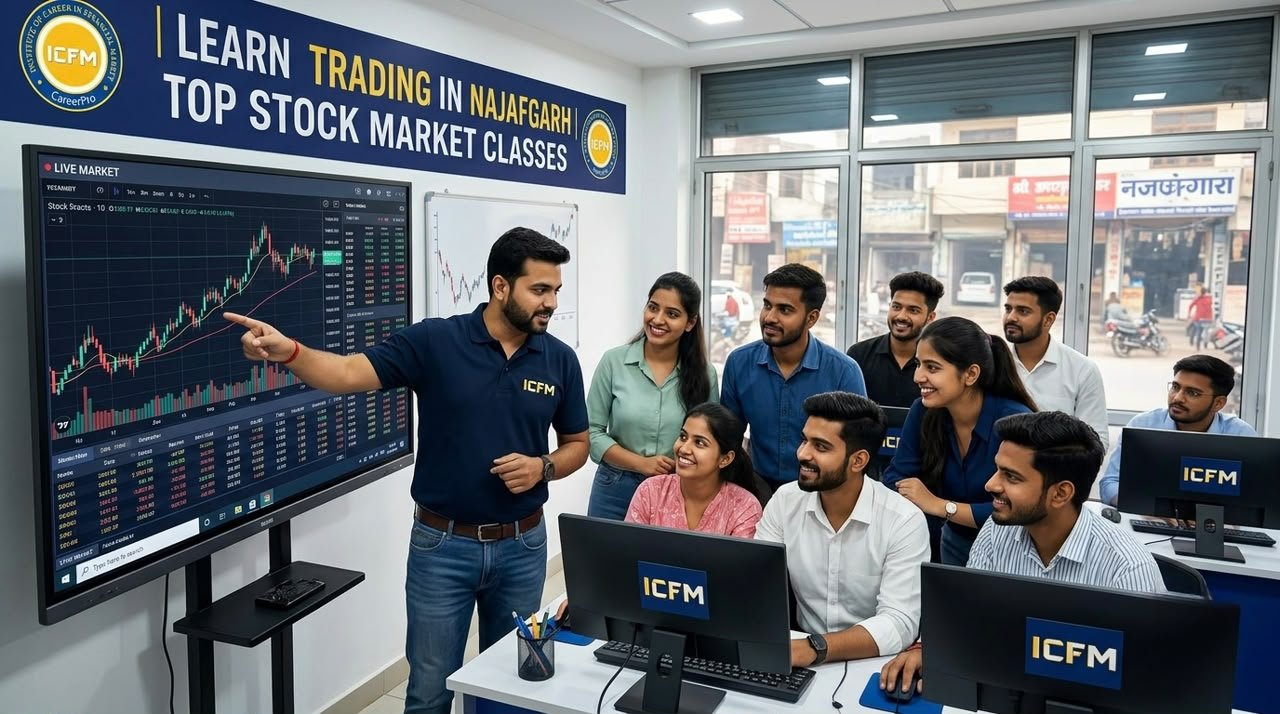
Learn trading with professional Trading Classes in Najafgarh at ICFM. Explore technical analysis, intraday trading, swing trading, investment, options, risk management and practical market learning.
The stock market has become an important part of India’s financial ecosystem. As more people explore trading and investing, the need for structured financial-market education has also increased. However, learning trading only through random videos, social media tips, or isolated strategies can make the learning process confusing.
Trading Classes in Najafgarh by ICFM are designed to provide learners with a structured understanding of the financial markets, from basic concepts to practical market analysis. Instead of focusing only on theoretical definitions, the training approach emphasizes understanding how markets work, how price movements are analyzed, how trades are planned, and how risk should be managed.
For students, working professionals, aspiring traders, investors, and individuals considering a career in financial markets, systematic training can provide a stronger foundation for making informed decisions.
Learn Trading with a Structured Approach
Trading is not simply about identifying whether a stock may rise or fall. A disciplined trader needs to understand several factors before considering a trade.
These include:
- Market structure
- Price movement
- Trading volume
- Technical indicators
- Support and resistance
- Trend identification
- Entry and exit planning
- Stop-loss placement
- Position sizing
- Risk-to-reward analysis
- Trading psychology
At ICFM, learners are introduced to these concepts progressively so that they can develop their understanding rather than attempting to memorize isolated trading tips.
The objective is to help students understand why a trading setup exists, how it can be evaluated, and what risks are involved.
Why Choose Trading Classes in Najafgarh?
Najafgarh and surrounding areas have a growing population of students, professionals, business owners, and individuals interested in developing financial skills. For learners in West and Southwest Delhi, accessing professional market education closer to home can make regular learning more convenient.
ICFM's trading education focuses on combining:
Concepts + Analysis + Practical Exposure + Risk Management + Career Preparation
This approach can help beginners build a foundation before moving toward more advanced market topics.
What Makes Professional Trading Education Different?
There is a significant difference between watching a trading video and following a structured learning program.
Online content can introduce you to candlestick patterns, indicators, or trading strategies. However, it may not explain how different concepts work together in an actual market environment.
A structured classroom or online program can provide:
1. A Learning Sequence
Beginners can start with financial-market fundamentals before moving into technical analysis, strategies, derivatives, and risk management.
2. Practical Market Understanding
Students can learn how charts behave, how market movements are interpreted, and how different market conditions affect trading decisions.
3. Risk Awareness
Understanding potential losses is just as important as identifying potential opportunities. Proper training introduces concepts such as stop-loss, position sizing, capital allocation, and risk-reward planning.
4. Consistent Methodology
Rather than changing strategies every time market conditions change, learners can develop a systematic framework for analyzing opportunities.
What You Can Learn in ICFM Trading Classes
The curriculum can be approached in multiple stages depending on the learner's existing knowledge.
Foundation of the Stock Market
Beginners first need to understand the environment in which trading takes place.
Topics may include:
- Introduction to financial markets
- Equity markets
- Stock exchanges
- Market participants
- Trading accounts
- Order types
- Market terminology
- Settlement basics
- Primary and secondary markets
A strong foundation makes advanced concepts easier to understand.
Technical Analysis and Chart Reading
Technical analysis is an important part of trading education.
Students can learn how to interpret historical price and volume information through charts.
Key areas include:
- Candlestick analysis
- Trend identification
- Support and resistance
- Chart patterns
- Price action
- Volume analysis
- Moving averages
- Momentum indicators
- Oscillators
- Breakouts and breakdowns
- Trend reversals
The goal is not simply to learn dozens of indicators. Instead, learners can understand how technical tools can be combined to develop a logical market-analysis process.
Intraday Trading Concepts
Intraday trading requires a different approach from long-term investing because positions are generally planned around shorter market movements.
Training can cover:
- Intraday market structure
- Selecting liquid instruments
- Identifying trading opportunities
- Entry and exit planning
- Stop-loss management
- Risk-reward evaluation
- Trade management
- Common intraday mistakes
A major focus should always remain on risk control and discipline, rather than unrealistic expectations about daily profits.
Swing Trading Strategies
Not every trader wants to monitor the market throughout the entire trading session.
Swing trading focuses on capturing potentially meaningful price movements over a longer period.
Learners can explore:
- Trend-following concepts
- Breakout setups
- Pullback strategies
- Support and resistance zones
- Momentum analysis
- Position management
- Trade planning
Understanding multiple approaches allows learners to identify a style that suits their objectives, availability, and risk tolerance.
Derivatives and Options Market Education
For learners who want to explore advanced trading, derivatives can be an important area of study.
Options and futures involve additional complexity and risk. Therefore, proper education is particularly important before attempting to trade these instruments.
Training may cover:
- Futures fundamentals
- Options terminology
- Calls and puts
- Strike price
- Expiry
- Premium
- Intrinsic and time value
- Option-chain interpretation
- Basic strategies
- Hedging concepts
- Risk considerations
The emphasis should be on understanding the mechanics and risks rather than treating options as a shortcut to quick returns.
Fundamental Analysis for Investors
Trading education does not have to be limited to charts.
For individuals interested in investing, understanding a company's financial position can be equally important.
Fundamental analysis may include:
- Revenue and profitability
- Balance sheet
- Profit and loss statement
- Cash flow
- Earnings
- Valuation ratios
- Business models
- Sector analysis
- Economic factors
- Company comparison
This helps learners distinguish between market price and the underlying business factors that may influence an investment.
Risk Management: The Most Important Trading Skill
Many beginners concentrate heavily on finding profitable strategies while giving insufficient attention to risk.
Professional trading education should reverse that approach.
Risk-management concepts can include:
Capital Allocation
How much capital should be exposed to a particular position?
Position Sizing
How should trade quantity be determined?
Stop-Loss Planning
Where should a trade be exited if the original analysis is invalidated?
Risk-to-Reward Ratio
Does the potential opportunity justify the amount of risk?
Diversification
How can concentration risk be managed?
Trading Discipline
How can emotional decisions be reduced?
Learning these principles can help students develop a more responsible approach to market participation.
Trading Psychology and Discipline
A technically strong strategy can still fail when emotions control decision-making.
Fear, greed, impatience, overconfidence, and revenge trading are common psychological challenges faced by market participants.
ICFM's training approach can help learners understand:
- Why traders make emotional decisions
- How overtrading develops
- Why chasing losses can be dangerous
- The importance of maintaining a trading plan
- How journaling can improve decision-making
- Why discipline matters over individual winning trades
The objective is to develop a process-oriented mindset rather than a prediction-oriented mindset.
Practical Learning with Trading Tools
Modern traders use technology extensively for market research and analysis.
Students can become familiar with tools and platforms used for:
- Chart analysis
- Market screening
- Price tracking
- Technical studies
- Trading research
- Order execution
- Market data analysis
Platforms and market resources such as TradingView, NSE resources, exchange information, screeners, and broker trading platforms can form part of practical learning.
Trading Classes in Najafgarh for Beginners
You do not need to be an experienced trader to begin learning.
ICFM's training can be useful for beginners who want to understand:
- How the stock market works
- How to read a basic chart
- What causes price movement
- How trades are executed
- What technical analysis means
- How investors evaluate companies
- Why risk management matters
Starting with fundamentals can prevent beginners from developing habits based on incomplete information.
Who Can Join These Trading Classes?
The program can be considered by:
College Students
Students interested in financial markets can develop practical knowledge alongside their academic education.
Fresh Graduates
Graduates looking to enter the finance industry can build market-related skills and improve their professional profile.
Working Professionals
Professionals can learn market concepts alongside their existing careers through suitable learning schedules.
Aspiring Traders
Individuals interested in active trading can develop a structured approach instead of relying on random market calls.
Investors
Long-term investors can strengthen their understanding of technical and fundamental analysis.
Career Switchers
Professionals considering a transition into financial services can use market education as part of their skill-development journey.
Trading Education with a Career Perspective
Trading knowledge can also be useful for people who want to explore employment opportunities within the financial-services sector.
Depending on qualifications, experience, and applicable regulatory requirements, learners may explore areas such as:
- Equity dealing
- Research support
- Investment operations
- Client servicing
- Financial sales
- Market analysis
- Trading desk support
- Broking operations
- Wealth-management support
A course alone does not guarantee employment or trading profits. However, structured training can help candidates build relevant knowledge and prepare more effectively for professional opportunities.
Why ICFM?
ICFM – Institute of Career in Financial Market has focused on financial-market education for learners interested in trading, investment, and related career paths.
The institute's training philosophy emphasizes practical understanding rather than simply completing a syllabus.
Key learning advantages include:
Structured Curriculum
Concepts are arranged progressively so beginners can develop their knowledge step by step.
Practical Market Exposure
Learners can connect classroom concepts with actual market examples and chart situations.
Technical and Fundamental Learning
Both trading-oriented technical analysis and investment-oriented fundamental analysis can be explored.
Career Orientation
Students interested in finance careers can receive guidance on relevant roles and professional preparation.
Mentorship and Doubt Support
Continued guidance can help learners clarify concepts as they progress.
Flexible Learning Options
Classroom and online learning options can make the program accessible to learners with different schedules.
A Better Way to Learn Trading
The strongest traders are not necessarily those who know the largest number of indicators or strategies.
A better learning process is built around four questions:
What is happening in the market?
Why might the setup be relevant?
Where is the trade idea invalidated?
How much risk is appropriate?
This mindset shifts trading education away from prediction and toward analysis, probability, planning, and discipline.
Common Mistakes Beginners Should Avoid
Before entering the market, new traders should understand some common mistakes:
Following Unverified Tips
Trading decisions based solely on social-media calls can expose beginners to unnecessary risk.
Trading Without a Plan
Entering a position without predetermined risk and exit conditions can make decisions emotional.
Excessive Leverage
Leverage can increase both potential gains and potential losses.
Overtrading
More trades do not automatically mean better results.
Ignoring Risk Management
Even a good strategy can experience losing trades.
Expecting Guaranteed Returns
Financial markets involve uncertainty. No legitimate training program can guarantee profits from trading.
Professional education should therefore focus on knowledge, preparation, and responsible decision-making.
Trading Classes in Najafgarh: Build Knowledge Before Taking Bigger Risks
Learning the stock market is a process.
First, understand the market.
Then learn how to analyze it.
After that, develop a trading or investment plan.
Finally, learn how to manage risk and review your decisions.
This progression can be much more valuable than searching for a single “perfect” trading strategy.
ICFM aims to provide learners with the educational foundation needed to understand these stages and approach financial markets with greater knowledge and discipline.
Start Your Stock Market Learning Journey with ICFM
If you are searching for Trading Classes in Najafgarh, ICFM offers a practical learning environment focused on stock-market education, technical analysis, investment concepts, risk management, and career development.
Whether you are starting from zero or already have some market experience, structured learning can help you organize your knowledge and develop a more disciplined approach.
ICFM – Institute of Career in Financial Market
Training Focus: Stock Market, Trading, Investment & Financial Markets
Location: Delhi
Website: www.icfmindia.in
Admissions Helpline: +91 9821210875
Learn the market. Understand the risk. Build the skill.

ICFM Admin
Senior Trading Analyst at ICFM India
Rahul Rai is a certified market professional with over 12 years of experience in equity and derivatives trading. He specializes in technical analysis and margin trading strategies, and has trained over 5,000 students through ICFM India's certification programs.