
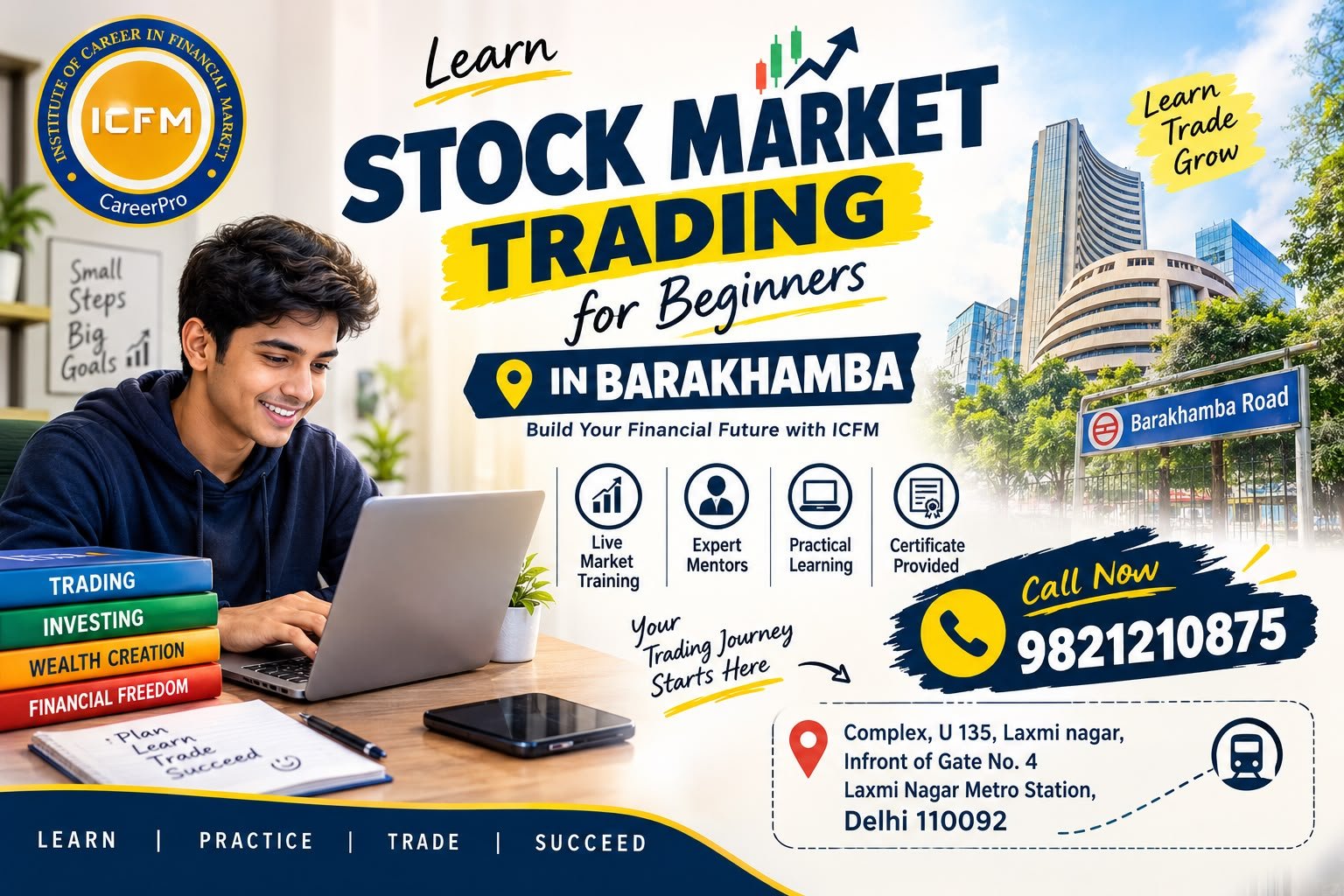
Learn how to start stock market trading in Barakhamba Road with beginner-friendly guidance on technical analysis, trading strategies, risk management, and stock market courses at ICFM.
Learning stock market trading requires more than opening a demat account, watching market videos, or following tips on social media. It requires a clear understanding of market movements, price behaviour, trading strategies, financial discipline, and risk management. For beginners searching for how to learn trading in Barakhamba Road, the first step is to choose a structured learning approach that builds knowledge progressively and encourages informed decision-making.
ICFM – Institute of Career in Financial Market provides stock market education designed to help learners understand the financial markets through theoretical concepts, analytical techniques, and practical market-oriented training. Whether you are a college student, working professional, aspiring finance executive, or beginner interested in trading, developing the right foundation can help you approach the markets more confidently.
The objective of learning trading should not be to chase quick profits. It should be to understand how markets function, identify opportunities responsibly, evaluate potential losses, and make decisions based on research rather than emotion.
Why Is Learning Stock Market Trading Important Today?
Financial markets involve multiple instruments, including equities, derivatives, exchange-traded funds, and other investment products. Each instrument has its own characteristics, costs, risks, and suitability considerations. Entering the market without understanding these differences can lead to avoidable mistakes.
A structured trading education can help you understand:
How stock exchanges and trading accounts work.
The difference between trading and long-term investing.
How price movements, volume, and market trends are analysed.
How technical and fundamental analysis support decision-making.
Why stop-loss planning and position sizing matter.
How trading psychology affects decisions.
How to evaluate strategies before risking real money.
For learners in Barakhamba Road and other parts of Delhi, the right course can provide an organised pathway from basic concepts to more advanced market analysis.
How Can Beginners Learn Trading Step by Step?
Step 1: Understand the Fundamentals of the Stock Market
Before studying complex strategies, learn the basic language of the market. Understand what shares represent, how stock exchanges operate, what brokers do, and how orders are placed and executed.
You should also understand the difference between market orders and limit orders, the purpose of a demat account, and the costs associated with trading.
A strong foundation helps beginners avoid confusion when they encounter unfamiliar market terminology or rapidly changing prices.
Step 2: Learn Technical Analysis
Technical analysis involves studying price charts, trading volume, trends, and indicators to evaluate possible market scenarios. It is an important area of study for people interested in short-term and medium-term trading.
A comprehensive technical analysis course may cover:
Candlestick charts and chart patterns.
Support and resistance levels.
Trendlines and price structures.
Moving averages and momentum indicators.
Volume analysis and breakout concepts.
Intraday and swing trading strategies.
Entry, exit, and stop-loss planning.
These tools do not guarantee accurate predictions. Their purpose is to help learners analyse market behaviour, define a trading plan, and assess potential risk.
Step 3: Study Fundamental Analysis
Technical analysis focuses primarily on market data and price behaviour, while fundamental analysis examines a company's financial condition and business prospects.
Learners should become familiar with balance sheets, profit and loss statements, cash flow statements, earnings, valuation ratios, industry performance, and broader economic factors.
Understanding both approaches can help learners distinguish between short-term trading decisions and longer-term investment analysis.
Step 4: Practise Before Using Real Money
One of the most valuable habits for a beginner is practising a strategy before committing capital. Paper trading and historical chart analysis can help you understand how a strategy behaves under different market conditions.
Maintain a trading journal that records your reasons for entering a trade, your planned exit, the risk involved, and the result. Review this journal regularly to identify recurring mistakes.
Real-market practice should be accompanied by supervision, realistic expectations, and an understanding that past performance does not guarantee future results.
Step 5: Develop Risk Management Skills
Successful learning involves understanding losses as well as potential gains. No trading strategy wins every time, and even experienced market participants can make incorrect decisions.
Important risk management concepts include:
Determining an affordable risk limit before entering a trade.
Using appropriate position sizing.
Understanding stop-loss orders and their limitations.
Avoiding excessive leverage.
Diversifying where appropriate.
Maintaining records and reviewing performance.
Avoiding decisions driven by fear, greed, or the desire to recover losses quickly.
Beginners should never trade with borrowed money or funds needed for essential expenses.
Step 6: Learn Trading Psychology and Discipline
Market knowledge alone is not enough. Emotional decision-making can lead to overtrading, impulsive entries, and ignoring a previously defined strategy.
A disciplined trader learns to wait for suitable conditions, follow predetermined rules, accept losses within a planned risk limit, and evaluate decisions objectively.
Developing these habits takes time and consistent practice. A structured learning environment can help students identify weak areas and improve their analytical process.
Choosing a Trading Course in Barakhamba Road
When comparing trading classes or institutes, do not select a course solely because it promises high returns or quick results. Evaluate the quality of the curriculum, the experience of the instructors, the amount of practical training, and the support available to learners.
Before enrolling, consider asking these questions:
Is the syllabus suitable for beginners?
A good learning programme should explain basic concepts before introducing advanced strategies.
Does the course include practical exercises?
Chart analysis, market case studies, simulated trading, and supervised exercises can help learners connect theory with application.
Are risk management and trading psychology covered?
These subjects should be central to the curriculum rather than treated as optional topics.
Are course fees and terms transparent?
Ask for a clear explanation of fees, course duration, assessment methods, and any additional costs.
Is career guidance available?
For learners interested in finance-sector employment, ask whether the institute provides interview preparation, career guidance, or placement assistance. Such assistance should not be confused with a guarantee of employment.
These checks can help learners from Barakhamba Road make a more informed decision when selecting stock market classes.
Why Consider ICFM for Stock Market Education?
ICFM – Institute of Career in Financial Market offers financial market education for learners who want to develop their understanding of trading, investing, and market analysis.
The learning approach can be explored by students who want to build foundational knowledge as well as learners seeking to develop more specialised analytical skills.
When evaluating ICFM or any other institute, review the current course syllabus, practical training format, faculty information, certification details, and support services before making an enrolment decision.
Key Areas to Explore at ICFM
Stock Market Fundamentals: Understand market structure, trading terminology, exchanges, and order execution.
Technical Analysis: Learn how to study charts, trends, price patterns, indicators, and volume.
Fundamental Analysis: Develop an understanding of company financial statements, valuation, and industry analysis.
Trading Tools: Become familiar with charting platforms and market research tools used for analysing price movements.
Risk Management: Study position sizing, stop-loss planning, capital preservation, and trading discipline.
Career Preparation: Explore relevant finance-sector roles and the skills commonly required for entry-level positions.
Course availability, certification recognition, placement assistance, and the delivery format should be confirmed directly with ICFM before enrolment.
Career Opportunities After Learning Trading
A stock market course can provide foundational knowledge relevant to several areas of the financial services industry. Depending on your qualifications, skills, experience, and applicable regulatory requirements, potential career pathways may include:
Equity dealing and broking operations.
Financial market research support.
Investment operations.
Client relationship roles in financial services.
Market data and analytical support.
Research assistance and financial reporting.
Further study in investment analysis and related finance disciplines.
Some regulated activities require specific qualifications, registrations, or certifications. Completing a trading course alone does not automatically qualify someone to provide investment advice or perform regulated professional functions.
Learners interested in self-directed trading should also recognise that it involves financial risk and does not guarantee a stable income.
Who Can Learn Trading?
Trading education may be useful for:
College Students: Learners interested in exploring financial markets and developing finance-related skills.
Working Professionals: Individuals who want to understand market analysis alongside their existing careers.
Beginners: People who have little or no prior knowledge of shares, charts, or trading platforms.
Aspiring Finance Professionals: Candidates who want to explore relevant roles in broking, operations, research support, or financial services.
Existing Investors: Individuals seeking to improve their understanding of market behaviour and risk.
You do not need to begin with advanced mathematical knowledge. However, patience, consistent study, analytical thinking, and a willingness to learn from mistakes are important.
Learning Trading Near Barakhamba Road: What Should You Consider?
Barakhamba Road is part of central Delhi's commercial district, making it a relevant location for professionals and students exploring educational options in the area. However, location alone should not determine your choice of institute.
Compare travel convenience, class schedules, online learning options, trainer interaction, course content, and practical exercises. If you are unable to attend classroom sessions regularly, ask whether an online or hybrid format is available.
ICFM's location is in Laxmi Nagar, Delhi, so learners travelling from Barakhamba Road should confirm the current classroom address, commute options, and available schedules directly with the institute.
A Practical 30-Day Plan for Trading Beginners
A simple learning plan can help you organise your first month of study.
Week 1: Market Basics
Learn stock market terminology, exchanges, trading accounts, order types, and the differences between trading and investing.
Week 2: Chart Reading
Study candlesticks, trends, support and resistance, volume, and basic indicators. Practise identifying these features on historical charts.
Week 3: Strategy and Risk
Learn how trading plans are developed. Study stop-loss placement, position sizing, risk-reward calculations, and trading psychology.
Week 4: Practice and Review
Use paper trading to test your understanding, maintain a journal, and review your decisions. Identify areas that require further study before considering real-money trading.
This is an introductory study plan, not a promise that a beginner will become a consistently profitable trader within 30 days. Skill development requires continued practice and evaluation.
Frequently Asked Questions
1. How can I learn trading in Barakhamba Road as a beginner?
Start with market fundamentals, learn technical and fundamental analysis, practise reading charts, and study risk management. You can also compare structured courses offered by financial market institutes such as ICFM.
2. Which course should I choose to learn stock market trading?
Look for a course that matches your experience level and includes a clear syllabus, practical exercises, risk management, trading psychology, and transparent fees. Compare the course details before enrolling.
3. Can I learn trading without prior experience?
Yes. Beginners can start with the basics and gradually progress to chart analysis, strategy development, and simulated practice. Consistent study is more useful than rushing into advanced techniques.
4. Is trading a guaranteed way to earn money?
No. Financial markets involve uncertainty, and traders can lose money. Education can improve your understanding of markets, but it cannot guarantee profits or eliminate risk.
5. Does ICFM offer career-oriented stock market education?
ICFM provides financial market education. Contact the institute to confirm current programmes, course formats, fees, certification details, and career support.
Start Your Stock Market Learning Journey with ICFM
If you are searching for how to learn trading in Barakhamba Road, begin by building a strong foundation instead of following unverified tips or pursuing unrealistic profit targets. Focus on understanding the market, practising analytical skills, managing risk, and making informed decisions.
ICFM – Institute of Career in Financial Market is an option to explore when comparing stock market education providers in Delhi. Review the available courses and speak with the institute to identify a learning path that fits your goals.
Institute: ICFM – Institute of Career in Financial Market
Address: Complex, U 135, Laxmi Nagar, In front of Gate No. 4, Laxmi Nagar Metro Station, Delhi – 110092
Phone: +91 9821210875
Email: info@icfmindia.in
Website: https://icfmindia.in/
Stock Market Course: https://icfmindia.in/organic-stock-market-course
Build your knowledge step by step, practise responsibly, and approach the financial markets with preparation, discipline, and realistic expectations.

ICFM Admin
Senior Trading Analyst at ICFM India
Rahul Rai is a certified market professional with over 12 years of experience in equity and derivatives trading. He specializes in technical analysis and margin trading strategies, and has trained over 5,000 students through ICFM India's certification programs.