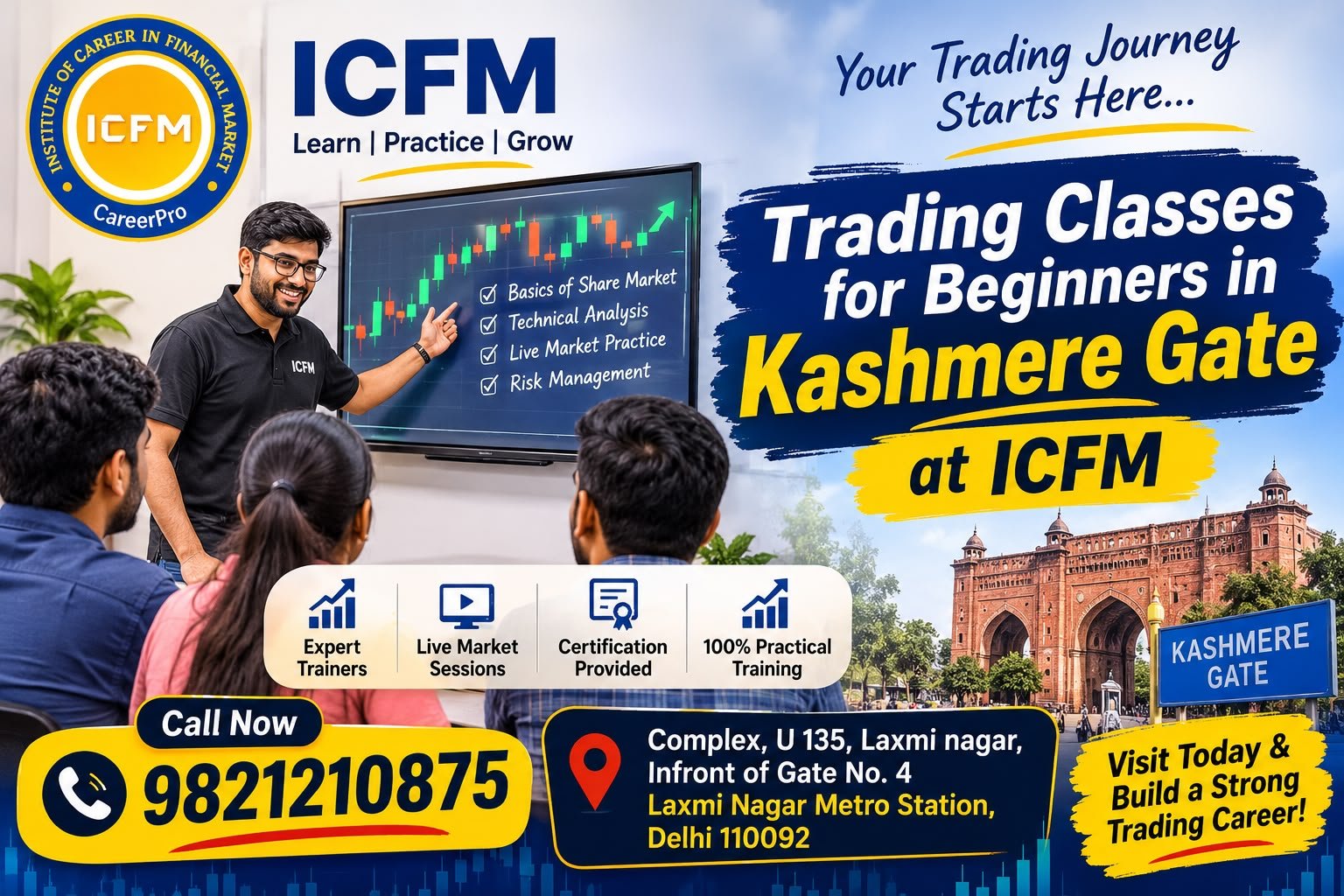
Looking for professional trading classes for beginners in Kashmere Gate? Join ICFM – Institute of Career in Financial Market to understand stock market fundamentals, technical analysis, trading strategies, risk management, and practical market applications through structured learning.
From Market Curiosity to Trading Knowledge: Start Learning the Right Way
The stock market often appears complicated to someone entering the financial world for the first time. Price movements, candlestick charts, market news, trading applications, and investment terminology can make beginners uncertain about where to start. Many people open trading accounts or follow online market discussions without understanding how the market actually operates.
This is where structured education becomes important.
If you are searching for trading classes for beginners in Kashmere Gate, ICFM – Institute of Career in Financial Market offers a learning environment where students can understand financial markets step by step. Instead of jumping directly into advanced trading techniques, learners begin with essential concepts and gradually develop the analytical skills required to understand market behaviour.
Our educational approach focuses on building knowledge, improving decision-making abilities, and understanding the practical aspects of trading and investment. The objective is to help beginners become informed market participants rather than depend on random tips, speculation, or unrealistic profit expectations.
Why Beginners Should Learn Trading Before Entering the Market
Trading is not simply about buying a stock at a lower price and selling it at a higher price. It involves studying market conditions, identifying opportunities, evaluating risks, and understanding the factors that influence price movements.
Without proper knowledge, beginners may struggle with:
Understanding stock market terminology.
Reading price charts and candlestick formations.
Identifying market trends and trading opportunities.
Selecting suitable trading timeframes.
Managing capital and controlling risk.
Understanding the difference between investing and trading.
Avoiding emotional decisions during market fluctuations.
A professional learning program helps address these challenges through a systematic curriculum.
At ICFM, beginners are introduced to the fundamentals before moving towards technical analysis, trading strategies, and practical market exercises. This progressive learning structure makes it easier to understand complex financial concepts.
What Makes Kashmere Gate a Convenient Location for Financial Market Learning?
Kashmere Gate is an established commercial and educational area in North Delhi. Its connectivity and accessibility make it a familiar location for students, working professionals, business owners, and individuals interested in developing additional professional skills.
People from Kashmere Gate and surrounding localities may be interested in learning stock market trading for different reasons. Some want to understand investments for personal financial awareness, while others wish to explore opportunities in the financial services industry.
ICFM welcomes learners interested in developing financial market knowledge through structured classroom and online learning options.
Whether you are a college student, a working professional, or someone completely new to trading, beginning with the right concepts can make your learning journey more organised.
Understanding the Beginner-to-Advanced Trading Learning Journey
A good trading education should not overwhelm beginners with complicated strategies from the first day. It should follow a logical progression, allowing students to understand one concept before moving to another.
Stage 1: Understanding the Indian Stock Market
The first step is understanding how the financial market works.
Students explore:
Introduction to the Indian stock market.
Primary and secondary markets.
NSE and BSE.
Equity shares and other financial instruments.
Demat and trading accounts.
Stock exchanges and market participants.
Market orders, limit orders, and order execution.
This foundation helps learners understand the environment in which trading takes place.
Stage 2: Learning to Read Stock Market Charts
Charts provide important information about price movements and market behaviour. Beginners learn how to interpret different chart formats and understand the information they communicate.
Topics include:
Line charts and candlestick charts.
Open, high, low, and close prices.
Bullish and bearish candles.
Candlestick formations.
Price action fundamentals.
Volume analysis.
Identifying support and resistance levels.
The purpose is to develop chart-reading skills instead of making decisions based on assumptions.
Stage 3: Introduction to Technical Analysis
Technical analysis helps traders study historical price and volume information to evaluate possible market opportunities.
The curriculum introduces:
Trend identification.
Moving averages.
RSI and MACD.
Momentum indicators.
Breakout and breakdown concepts.
Chart patterns.
Trendlines and trading channels.
Multiple-timeframe analysis.
Beginners gradually learn how these tools can support market analysis. No indicator or chart pattern guarantees a profitable trade, so understanding limitations is equally important.
Stage 4: Developing Basic Trading Strategies
Once students understand charts and technical concepts, they can begin exploring structured trading approaches.
Learning areas include:
Introduction to intraday trading.
Swing trading fundamentals.
Positional trading concepts.
Entry and exit planning.
Identifying potential trading setups.
Understanding market volatility.
Trading with predefined rules.
Students learn why a trading strategy should be evaluated and practised rather than followed blindly.
Stage 5: Risk Management and Trading Psychology
One of the most important aspects of trading education is understanding how to protect capital.
The course introduces:
Stop-loss planning.
Position sizing.
Capital allocation.
Risk-to-reward concepts.
Diversification fundamentals.
Maintaining a trading journal.
Controlling emotional decisions.
Avoiding overtrading.
A responsible trader understands that managing losses and controlling risk are essential parts of the learning process.
Stage 6: Practical Market Tools and Applications
Modern trading involves several digital platforms and analytical tools. Beginners need to understand how these tools work before applying their knowledge.
Students can explore:
TradingView charting tools.
Stock screeners.
NSE and BSE market information.
Technical indicators.
Chart customisation.
Market observation.
Basic trade analysis.
Practical demonstrations help connect classroom concepts with actual market information.
Why Choose ICFM for Trading Classes for Beginners?
ICFM – Institute of Career in Financial Market focuses on financial market education through structured learning, practical exposure, and career-oriented knowledge.
Our approach is built around the idea that students should understand the reasons behind market movements rather than memorise trading techniques.
A Learning Approach Designed Around Students
1. Beginner-Friendly Teaching
Students start with fundamental concepts, making the learning process accessible even without previous stock market experience.
2. Concept-Based Technical Analysis
Learn how charts, indicators, trends, and price movements are interpreted through organised lessons.
3. Practical Market Understanding
Explore real market information and analytical tools to understand how theoretical concepts relate to market conditions.
4. Structured Course Progression
Move from basic financial knowledge towards more detailed trading and investment concepts.
5. Experienced Faculty Guidance
Learn with guidance from financial market educators and professionals who explain market concepts and analytical approaches.
6. Career-Oriented Knowledge
Explore the skills associated with equity dealing, financial research, market operations, and other finance-related roles.
7. Classroom and Online Learning Options
Choose a suitable learning format based on your availability and educational requirements.
Trading Classes vs Learning Trading Through Random Online Videos
The internet offers thousands of trading videos, but collecting information from different sources does not always create a complete understanding of the market.
| Learning Factor | Structured ICFM Training | Random Online Learning |
|---|---|---|
| Learning sequence | Organised curriculum | Often unstructured |
| Basic concepts | Step-by-step explanation | May skip fundamentals |
| Technical analysis | Structured topic coverage | Depends on the creator |
| Practical understanding | Guided market exercises | Self-directed practice |
| Doubt clarification | Faculty guidance | Limited or inconsistent |
| Risk management | Included in learning | May receive less attention |
| Career preparation | Career-oriented guidance | Usually self-managed |
The difference is not simply the amount of information available. It is how effectively that information is organised, explained, and applied.
Career Opportunities After Learning Stock Market Trading
Trading education can help learners understand several areas of the financial services industry. Depending on their qualifications, practical abilities, relevant certifications, and regulatory requirements, learners may explore opportunities such as:
Equity Dealer.
Stock Market Operations Executive.
Research Support Executive.
Financial Market Associate.
Trading Desk Assistant.
Investment Operations Executive.
Client Relationship Executive.
Financial Education Professional.
Students interested in independent trading can also develop their market knowledge through continuous practice and disciplined analysis.
It is important to understand that completing a course does not automatically guarantee employment, registration as an investment adviser, or trading profits. Certain professional roles require additional qualifications or regulatory registrations.
Who Can Join These Beginner Trading Classes?
ICFM's beginner-oriented learning approach can be suitable for:
College Students: Develop financial market knowledge alongside academic education.
Fresh Graduates: Explore the financial services industry and understand the skills used in market-related roles.
Working Professionals: Develop an additional area of knowledge and explore career development opportunities.
First-Time Traders: Understand market fundamentals before making independent trading decisions.
Existing Investors: Improve their understanding of charts, technical analysis, and market behaviour.
Business Owners and Entrepreneurs: Develop a better understanding of financial markets and investment concepts.
Career Switchers: Explore financial market education as part of a broader professional development plan.
No previous trading experience is necessary to begin learning the fundamentals.
How to Choose the Right Trading Classes as a Beginner
Before enrolling in any stock market training program, it is important to evaluate the quality and suitability of the education being offered.
Consider these factors:
Course Curriculum: Check whether the program covers market fundamentals, technical analysis, trading strategies, and risk management.
Teaching Methodology: Prefer a learning structure that explains concepts clearly instead of promoting shortcuts.
Practical Exposure: Understand whether students get opportunities to observe and analyse market information.
Faculty Guidance: Check whether instructors can clarify doubts and explain market concepts.
Career Relevance: Evaluate whether the curriculum introduces skills relevant to financial market roles.
Fee Transparency: Understand the course fee, duration, inclusions, and other applicable charges before admission.
Realistic Expectations: Avoid institutes or individuals promising guaranteed trading profits or assured employment.
Making an informed choice can help you invest your time and money in meaningful financial education.
Frequently Asked Questions About Trading Classes for Beginners in Kashmere Gate
Q1. Can a complete beginner join trading classes at ICFM?
Yes. Beginners can start with the basic concepts of financial markets and gradually learn chart reading, technical analysis, and trading fundamentals.
Q2. Do I need a commerce or finance background to learn trading?
No. Students from different educational backgrounds can begin learning stock market concepts. Interest, consistent learning, and regular practice are important.
Q3. What is the first thing a beginner should learn about trading?
A beginner should understand stock market fundamentals, exchanges, trading accounts, order types, and basic financial terminology before studying advanced strategies.
Q4. Will I learn technical analysis during the course?
The learning curriculum introduces technical analysis concepts such as candlestick patterns, support and resistance, indicators, trend analysis, and chart interpretation.
Q5. Are practical market sessions important for beginners?
Yes. Practical demonstrations help students understand how market concepts and analytical techniques are applied to real market information.
Q6. Can I pursue a finance career after learning trading?
Trading education can help develop relevant knowledge for exploring financial market roles. Employment opportunities also depend on academic qualifications, skills, experience, and applicable regulatory requirements.
Q7. Does learning trading guarantee profits?
No. Financial markets involve risk, and neither training nor technical analysis can guarantee profits. Education helps learners make more informed decisions and understand risk.
Start Your Financial Market Learning Journey with ICFM
Choosing the right trading education is an important first step towards understanding the financial markets. Rather than relying on incomplete information, beginners should focus on building a strong foundation, learning analytical techniques, and developing disciplined decision-making habits.
At ICFM – Institute of Career in Financial Market, the emphasis is on helping learners understand the market through structured education and practical knowledge.
If you are exploring trading classes for beginners in Kashmere Gate, connect with ICFM to understand the available programs, course structure, admission process, and suitable learning options.
Contact ICFM – Institute of Career in Financial Market
Institute: ICFM – Institute of Career in Financial Market
Address: Complex, U 135, Laxmi Nagar, In front of Gate No. 4, Laxmi Nagar Metro Station, Delhi – 110092
Email: info@icfmindia.in
Phone: +91 9821210875
Official Website: https://icfmindia.in/
Stock Market Course: https://icfmindia.in/organic-stock-market-course
Your journey into the financial markets starts with knowledge. Learn the fundamentals, understand market behaviour, and develop your trading skills with ICFM.

ICFM Admin
Senior Trading Analyst at ICFM India
Rahul Rai is a certified market professional with over 12 years of experience in equity and derivatives trading. He specializes in technical analysis and margin trading strategies, and has trained over 5,000 students through ICFM India's certification programs.